William Huntington Sanders
William Huntington Sanders, a Harvard graduate and one of Theodore Roosevelt’s Rough Riders, served bravely in the Spanish-American War as Roosevelt’s orderly during the Battle for San Juan Hill, ultimately dying of illness at age 26 after enduring the brutal conditions of war and a tragic lack of medical care.
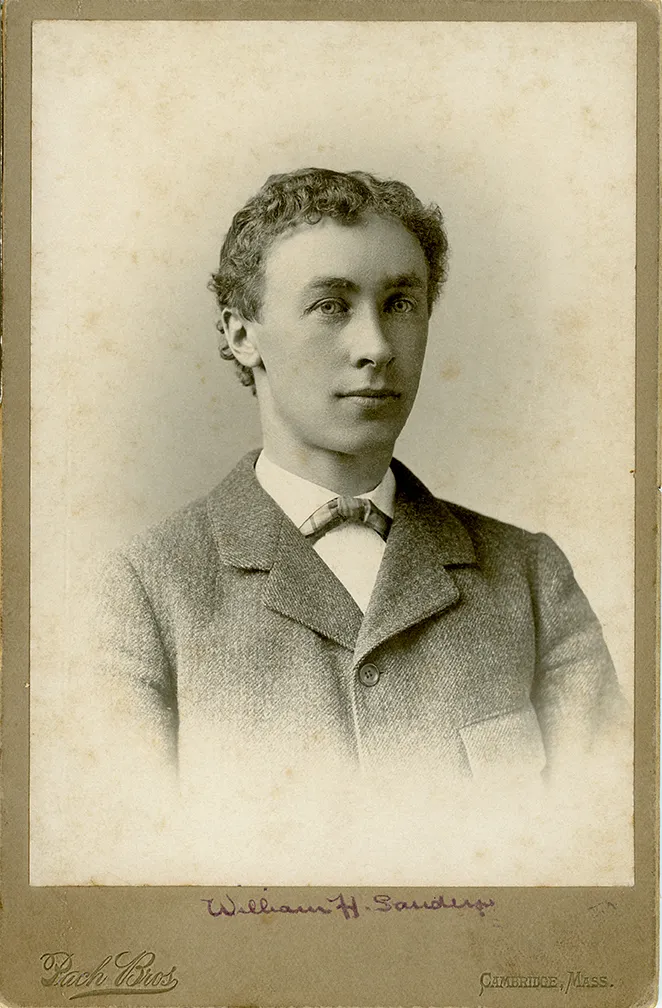

William Huntington Sanders
William Huntington Sanders
December 26, 1871 - August 12, 1898
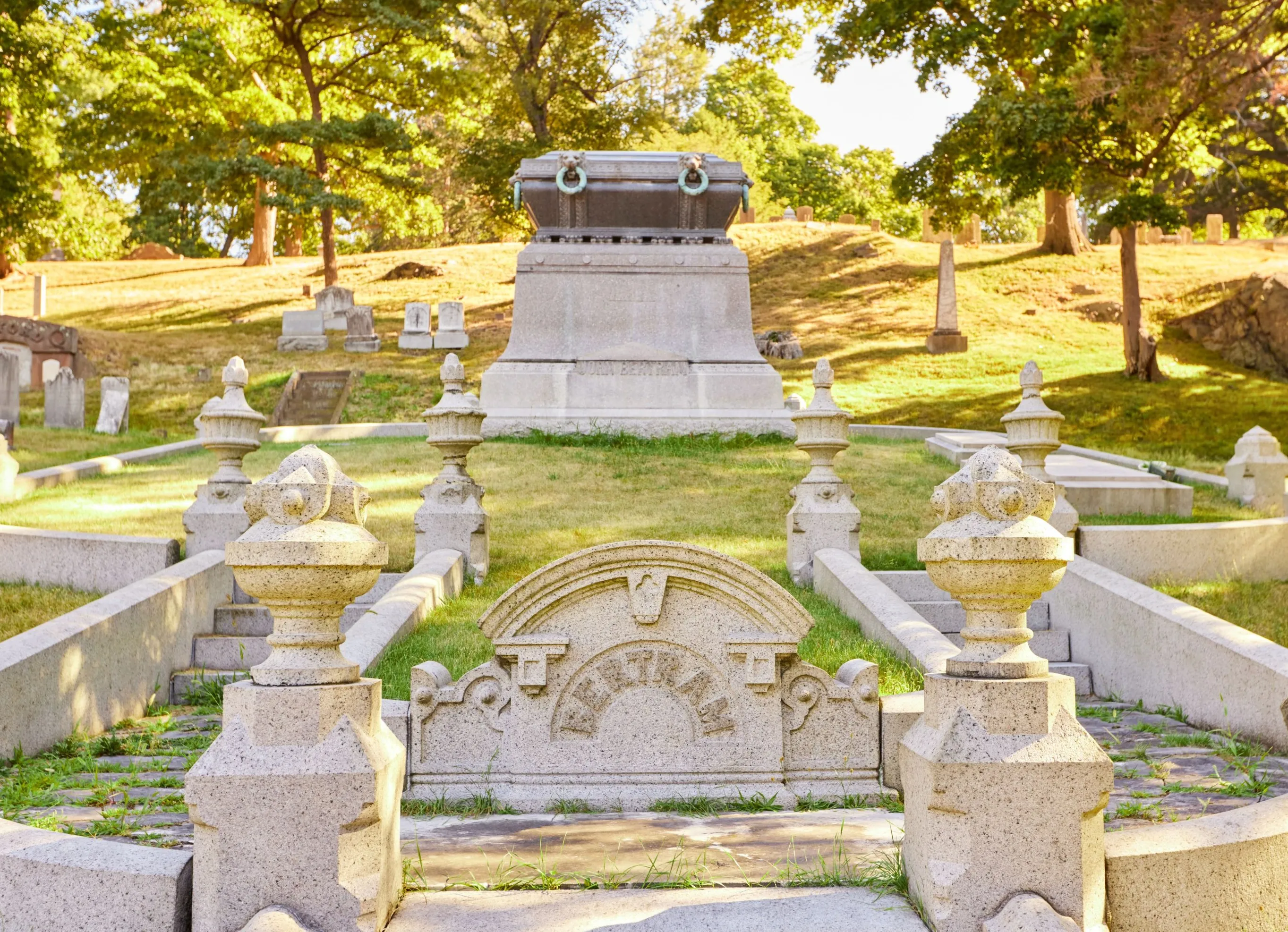
Burial Lot 1615, #3, Halidon Ave.
One of Theodore Roosevelt’s Rough Riders, he fought in every conflict in the Spanish American War and served as Roosevelt’s orderly in the Battle for San Juan Hill.
William Huntington Sanders was born on December 26, 1871. The second of 5 children born to Charles Sanders and Helen Lord Sanders of Salem, “Bill” experienced a childhood of affluence and privilege in a grand home in Salem and on a farm in Peabody, where the family raised horses. He attended MIT, then Harvard’s Lawrence Scientific School, graduating in the class of 1897.
In spring of 1898, when the US declared war on Spain to gain independence for Spain’s colony Cuba, Theodore Roosevelt stepped down from his cabinet position as Assistant Secretary of the Navy to lead the First U.S. Volunteer Cavalry as Lt. Colonel. To fill the ranks of this new regiment, Roosevelt set out to assemble some of the finest men he knew. He sought recruits among the hardy western horsemen with whom he had lived for several years, and the east coast elite he had grown up with. He wrote to friends in New York and Boston, seeking fighting men from New York’s best clubs and New England’s best colleges. One such letter was to Guy Murchie of Cambridge, MA, an 1892 graduate of Roosevelt’s alma mater Harvard and afterward Harvard Law School, who remained on campus as an assistant football coach, and was well known by current students and recent graduates. Murchie gathered a group of 41 Harvard men who, because of the continued deluge of letters from allover the country from others wishing to serve, were sworn to secrecy about their intent. The Harvard men left Boston by train at midnight on May 2nd,with no one to see them off, and arrived in Washington D.C. the next afternoon. Among them was William Huntington Sanders, who had not told his parents what he planned to do.
On May 4th, 1898, after meeting with Lt. Colonel Roosevelt, Bill was selected to join the First United States Volunteer Cavalry Regiment, soon to be dubbed the “Rough Riders.”
In a letter home to his parents on that same day, Bill disclosed the purpose of his trip to D.C. “Dear Papa,…today I with 11 others joined the First Cavalry Volunteers. Just what my position will be I do not know yet. The others are all Cambridge (Harvard) men. I did not tell you what I expected todo because I knew you would all object, which would not have altered my plans. I thought the step over carefully before I took it and do not think that I will regret it. I have consulted good physicians and do not think that I will have any trouble with my health.”[1]
Bill went immediately to San Antonio Texas to begin training. There calvary troops A, B, C, and D were formed. On May 12th Bill writes: “troops A, B and C are made up of Arizona men, and D of Oklahoma. The men are tough but good hearted and we got a surprisingly cordial greeting from them when we arrived; surprising because Western cowboys are not as a rule partial to Easterners” In Roosevelt’s words: “I suppose every man tends to brag about his regiment; but it does seem to me that there never was a regiment better worth bragging about than ours…the rank and file were as fine natural fighting men a sever carried a rifle or rode a horse in any country or any age. We had a number of first class young fellows from Harvard, Yale, and Princeton; but the great majority of the men were South westerners, from the then territories of Oklahoma, Indian Territory, Arizona, and New Mexico.”[2]
In the letters to his parents that followed, Bill provided details about his experiences. The heat and mosquitos in San Antonio, bad food, the long hours of drilling with men with no previous military experience. In every letter he makes reference to his health, always positively. He writes on May 22nd: “things are pretty well straightened out here and the regiment is fast becoming a military organization, and not an armed mob which it was at first.” The Rough Riders, who by then had captured the nation’s imagination as a group of brave and adventurous men who represented every aspect of American life, traveled by train to Tampa, FL, and were greeted at every stop by people offering food, flowers, gifts and well wishes. On June 8th they boarded transport ships to Cuba, but due to lack of space only the officers were able to bring their horses, and some of the troops were left behind entirely. The ships landed on June 22nd roughly 10 miles east of Santiago. On June 25th, Bill writes: “Dear Mama, our regiment met a body of Spaniards in the hills near Santiago yesterday and forced them to retreat to their entrenchments although they had about 2500 to our 800….I expect we shall be in Santiago inside of 3 days….Health is A1.”
What followed 10 days later was to be the battle that turned the tide in favor of the Americans and eventually won the war - the Battle for San Juan Heights. Facing hills of open fields guarded at the top by barricades with heavily armed Spanish, the Rough Riders and fellow infantry men were at a distinct disadvantage. Disaster for the regiment was averted when Gatling guns were hauled into place, and provided the cover needed for the American soldiers to advance up the open hillside. The Gatlings were a new lethal weapon with multiple barrels that could continuously fire hundreds of rounds per minute. With the sound of the Gatlings’ rhythmic firing cheering them, Roosevelt and his men charged up the hill, overtaking the Spanish defenses.
On July 19th, Bill writes: “Dear Mama, On the afternoon of the (June) 30th, we broke camp and moved to a position about four miles from Santiago to support a battery of artillery on a small hill within range of the entrenchments and block houses outside Santiago. This was the left side of the line of attack commanded by General Wheeler, the right being under Lawton. At daylight the ball opened with the artillery. For some time our guns fired on the block houses and entrenchments without any response from the Spanish .But one or two guns finally retuned our fire and the gunners had our range down pretty fine for the very first shell exploded amongst our men…One was killed and several wounded…Had a good chance to see this as I was Col. Roosevelt’s orderly for the day and he was among the last to leave the hill. Our battery stuck to it notwithstanding the fact that our gun was dismounted and in about half an hour had silenced the enemies guns. We, the dismounted cavalry then moved up to assault the rifle pits and entrenchments, block house, etc. on the Spanish left. Here while deployed as skirmishes there was some misunderstanding of orders. We were ordered to stay in support of the infantry who were to do the assaulting but our regiment was laying exposed to such a heavy fire that we were ordered to take part in the assault. Col Roosevelt and others did not make this plain to all the troop commanders so less than half the regiment moved up. Teddy is brave as a lion but… In his rushing about on horseback he lost Willie, who was not speedy enough to keep up, so I was not in front when Teddy led the assault. Perhaps it was lucky I was not, but still I had to expose myself to a heavier fire in hunting for my colonel than if I had actually been with him. Luck was with me and I never got a scratch although I had some uncomfortable close shaves. The Spaniards deserted their strongholds just as they did before, just when they would have been most effective, had they stayed and fought. In the latter part of the afternoon I found Teddy, after I had traveled up and down our line about a dozen times. By this time the Spaniards had retired to their city strongholds and we held their positions outside. Towards evening they attempted to drive us back, but we showed them how to fight from a stronghold and drove them back without any trouble although we did not have many men on the fighting line. All that night we worked like beavers digging rifle pits, although we hadn’t had a bit of food since daylight, and in the morning we had entrenchments that all the Spaniards in Santiago could not have taken. Soon after daylight firing on both sides commenced. Almost the first shell fired by the enemy exploded just over the troops supporting the pits and killed two and wounded three…The firing was kept up nearly all day and late into the night when the Spanish made an unsuccessful attempt to breakthrough. On July 3rd at 12 o’clock, a flag of truce was raised and negotiations for a surrender (began).”
Letter dated July 25th, 1898: “I got two letters from you last evening, one dated July 1st and the other July 6th, also one from Dudley written July 6th. These are the first home letters I have received since landing on the island over a month ago. We are still camped in the hills several miles outside Santiago. What is to be done with us no one here seems to know. My theory is that we are to be held here to reinforce the Puerto Rico expedition if necessary. Malarial fever and dysentery seems to be about the only sickness among the soldiers. Don’t believe the yellow fever stories in the papers, for I have not heard of a single case among the soldiers. Col. Roosevelt tells me he received another telegram from you; they are quite unnecessary. My health all right. Love to all, Bill”
Postcard dated July 30th, 1898 “Dear Mama, No change in our affairs except that it was announced a few days ago that we were to betaken to the States as soon as possible for a much needed rest, which they have realized is impossible, situated as we are now. The announcement said that we were to be taken to Long Island. Sounds too good to believe. At any rate we are pretty sure to be moved somewhere very soon. I have written you 6 or 7 times since writing the postal on the 25th, but I know that there is or has been very no system or effort made to handle mail decently. The postal you got I gave to a sailor off one of our warships who was on shore leave. Got a letter from you mailed on the 15th, the quickest yet. How is Grandma. Give her and all the others my love, Bill Health good” (written sideways on the edge of the card)
Unfortunately, despite his reassurances about his health to his parents, Bill had already had two bouts of malaria after July 1, and his health had deteriorated so much that on July 30th, the same day he wrote the last card to his parents, an ambulance was called for him. The ambulance never arrived, so his comrade Dudley Dean took him on horseback to Santiago, where he left Bill in the care of a steward of the Marine Hospital, with the steward’s promise to have him transferred to a hospital ship in the Bay before sundown. This promise was not kept, and Bill lay for two days in the Piazza of the Hospital, while receiving no care. He was finally transferred to the ship Los Angeles, where on August 12th, 1898 he died. He was 26 years old.
In an account of the Battle for San Juan Heights in his book “The RoughRiders,” Colonel Roosevelt said of him: “My orderly was a brave young Harvard boy, Sanders, from the quaint old Massachusetts town of Salem. The work of an orderly on foot, under the blazing sun, through the hot and matted jungle, was very severe, and finally the heat overcame him. He dropped; nor did he ever recover fully, and later he died from fever.”[3]
Bill’s death must have seemed an avoidable and senseless tragedy for his family and many friends, who were undoubtedly haunted by the circumstances of his final days. He was not the only Rough Rider to end his life in this way. Disease claimed the lives of hundreds of members of his regiment, some after returning to the U.S., and others remained ill for months after the war ended.
Bill’s funeral, held in Salem on the afternoon of Sept. 15, 1898, at the North Church was conducted by Rev. George D. Latimer. “Bells tolled in Salem and business was suspended, while “Old Glory” hung at half-mast from every staff in the city. After the service, the body was placed in the hearse and under escort of the Salem Cadet Band, Second Corps Cadets, Post 34, G.A.R., the Salem Light Infantry Veteran Association, and representatives of the Eighth Mass Regiment then at home on furlough, the march was taken up for Harmony Grove, where after the customary three volleys and sounding of taps, the body was lowered into the grave.”[4]
Among the tributes to William Huntington Sanders was the remembrance of him in a Harvard 1897 alumni publication: “The characteristics which caused Sanders to gather about him devoted friends were his complete independence of thought and action, combined with his unfailing consideration for everyone with whom he came in contact. His was a normal and wholesome nature. He was sanguine, but even in temperament, and always ready to participate in any good activity. He was never ruffled at mishaps, and always insistent on doing his fair share of every kind of work. He had a strong inclination for a kind of out-of-door life, and spent a considerable part of his leisure in the woods; he possessed that magnetism which is born of good health and self-restrained enthusiasm. He was obstinately loyal and absolutely true - in short, his characteristics were such as make up a perfect friend.”[5]
Months after his death, Bill’s father Charles wrote to Theodore Roosevelt, now governor of New York, enclosing a letter from Bill. On January 3rd, 1899 Roosevelt answered: “I am only too glad to have this chance of saying what a fine gallant soldierly young fellow he was. There was no braver or more trustworthy man in all the regiment, and it is a great grief to feel that bright and gallant young life is closed. But he did his duty in every way, on the march, in camp, and in battle. He was one of the best men in a fighting regiment and he has left a name of honor behind him. With deep regret, believe me, Faithfully yours, Theodore Roosevelt.” Charles wrote again asking to meet Roosevelt, to which Roosevelt replied: “ My dear Mr. Sanders, it would give me particular pleasure to see you. I shall come next Saturday by the 1 p.m. fast train from New York, I shall expect to see you at Willimantic. Truly yours, Theodore Roosevelt.”[6]
No record remains of their meeting and conversation.
Text and photo: Martha Baldwin Sanders.
Sources Consulted:
[1] Excerpts of letters from William H. Sanders to his parents are from the Sanders Family collection.
[2] From “The Rough Riders,” Theodore Roosevelt
[3] From “The Rough Riders,” Theodore Roosevelt
[4] Greater Salem in the Spanish American War, by Harry E. Webber
[5] Harvard 1897 Alumni Second Report
[6] Letters from Theodore Roosevelt to Mr. and Mrs. Charles Sanders, Harvard Library Collection
Join the Community
Support Harmony Grove and be among the first to hear about our programs.